
A rusty cast iron skillet is fixable at home in about 1 to 2 hours of hands-on work, plus a re-seasoning session of around 1 hour in the oven. Cleaning rust from a cast iron skillet comes down to one idea: rust is iron meeting moisture, so you strip it back to bare metal, remove every speck of orange, dry it completely, and bake on a fresh oil layer.
The job is medium-hard — easy if the rust is a light surface bloom, harder if it has pitted the metal. The one thing you must have before starting is a rust-free, fully dry pan before any oil touches it.
What you need
| Item | How much | Why it’s needed | A substitute | |—|—|—|—|—| | White vinegar | 1 cup, for light rust | Dissolves surface rust without deep damage | None — don’t swap this | | Steel wool or scouring pad | 1 pad, medium grade | Lifts rust off the iron surface | Coarse salt with a stiff brush | | Stiff nylon brush | 1 small | Reaches corners and the handle | Old toothbrush | | Dish soap | 1 teaspoon per wash | Cuts old grease and loose rust | None — don’t swap this | | Neutral cooking oil | 1 tablespoon, high smoke point | Builds the new seasoning layer | Flaxseed or canola oil | | Paper towels or clean cloth | 3 to 4 sheets | Wipes oil thin and dries the pan | Lint-free kitchen towel | | Oven | Set to 450°F to 500°F | Bakes the oil into a hard layer | Stovetop seasoning, slower |
Gather everything before you touch the pan, because the vinegar starts working the moment the iron goes in.
Keep the vinegar in a glass or ceramic bowl, not a metal one. A metal bowl can react with the acid and leave you guessing whether the rust is gone or the bowl is.
Medium-grade steel wool is the right starting point for a skillet with scattered rust. Save the coarse grade for a pan that has sat outside or in a damp garage, where the rust has had time to pit the surface.
Check the oven rack position first. Put it in the middle, and clear out anything stored on the lower rack that could scorch at 450°F to 500°F.
If your oven runs hot, an inexpensive oven thermometer clipped to the rack tells you what the dial does not. Seasoning depends on the real temperature, not the number you set.
A lint-free kitchen towel works better than paper towels for the final wipe, since it leaves no fibers behind in the oil.
Before you start on a rusty skillet
- Move the smoke out. Open a window and turn on the exhaust fan before the oven reaches 450°F. Seasoning oil smokes, and a small kitchen fills fast.
- Empty the oven. Take out trays, foil and the pizza stone. A crowded oven heats unevenly, and the pan needs clear space on the middle rack.
- Check the rust depth first. Run a fingernail across the orange patches. If the metal feels smooth under the color, it’s surface rust. If your nail catches in pits, the iron itself is eaten away.
A skillet with light surface rust is worth the effort. One with deep pitting may never hold a slick season again, because the oil can’t bridge the holes.
Look closely at the cooking face, not just the outside walls. Rust on the bottom is common and usually shallow. Rust in the center of the pan, where a spatula scrapes daily, is the spot that decides it.
- Cover your work surface. Vinegar and rust stain wood and fabric. Lay down newspaper or an old towel before you start scrubbing.
- The step people skip: drying the pan completely before oiling. Water left on the surface is the main reason rust comes straight back.
If the pan is cracked, warped, or has rust holes through the metal, stop. That’s a replacement job, not a cleaning job. Take it to a metal recycler rather than cooking on it.
How to clean a rusty cast iron skillet, step by step
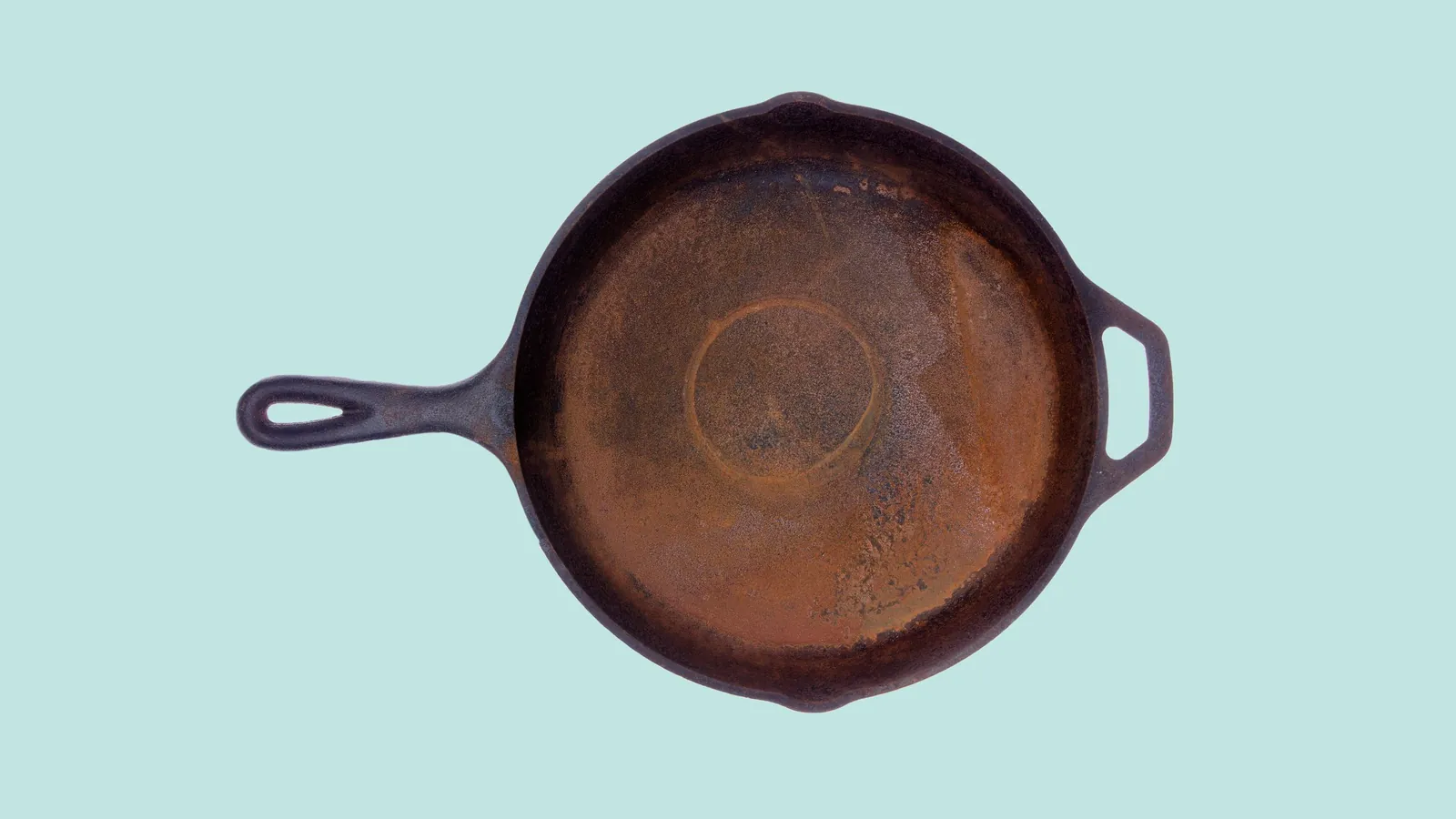
Wash off loose dirt first. Scrub the pan with hot water and 1 teaspoon of dish soap for about 2 minutes. Rinse and pat dry. You’re removing grease and loose flakes so the vinegar can reach the rust. The pan should look dull but even before you move on.
Soak the rusty areas in vinegar. Pour 1 cup of white vinegar into the pan, or lay the pan face-down in a tray of vinegar if the rust is on the outside. Set a timer for 30 minutes for light rust. Don’t walk away — vinegar left too long starts eating good iron.
Scrub the rust off. Pull the pan out and scrub the orange patches with steel wool in small circles for 3 to 5 minutes. Re-wet the wool with vinegar as needed. You’re done when the metal under the patch looks grey-black, not orange, and your fingertip feels smooth iron.
Rinse and neutralize. Rinse under hot water, then wipe the whole pan with a paper towel dipped in a little baking soda solution, and rinse again. This clears the last rust dust out of the pits. The water should run clear, with no orange tint, before you continue.
Dry it completely — twice. Towel-dry the pan, then set it on a stovetop burner over low heat for 5 to 10 minutes. You’ll see the last moisture lift off as faint steam. Once no steam rises, the pan is dry. Skip this and the rust returns within days.
Heat the oven to 450°F. Move a rack to the middle position. Let the oven come fully up to temperature, about 10 to 15 minutes. A cold oven gives you a patchy, sticky seasoning instead of a hard, even one.
Oil the pan thinly. Pour 1 tablespoon of neutral oil into the warm pan. Rub it over every surface — inside, outside, handle, and the rim — with a paper towel. Then wipe it off with a clean towel until the pan looks almost dry. Thin is the whole secret.
Bake it upside down. Place the pan upside down on the middle rack, with a sheet of foil on the rack below to catch drips. Bake for 1 hour. The pan should come out dark brown to black and dry to the touch, not tacky.
Cool it slowly. Turn the oven off and leave the pan inside for 30 to 40 minutes. Sudden cold air can crack hot iron. The pan is ready when it’s cool enough to hold with a bare hand.
Check the surface and repeat if needed. Run a dry paper towel across the cooking surface. If it comes away clean and the pan looks even and dark, you’re done. If you see bare grey spots, repeat steps 7 and 8 once more.
How to tell the rust is really gone
The clearest sign is color and feel together. Tilt the pan toward a window: the cooking surface should read dark grey to black all over, with no orange or brown patches left. Run a dry fingertip across it — smooth iron, no grit. Then wipe with a white paper towel; it should come away clean. That’s your check, and it beats guessing from a photo.
The second sign is behavior. Drop a few water droplets on a properly seasoned pan and they bead up and roll instead of spreading. That beading shows the oil layer is intact, which is what keeps rust from coming back.
A pan that needs another round shows one of three things. Bare grey or silver patches mean the oil didn’t cover that spot — oil and bake again. A sticky, tacky surface means the oil went on too thick — scrub it lightly with hot water and a nylon brush, then re-oil thinner. Rust creeping back within a week means moisture got trapped — dry it on the stove longer next time.
How much rust comes off depends on how deep it went. Light surface rust on a well-kept pan lifts in one 30-minute vinegar soak. Pitted rust on a pan left in a damp garage can need two or three rounds, and some of the dark mottling stays forever. Read your own pan’s surface after the first scrub — smooth means one more round, rough and pitted means plan for several.
When the rust cleanup goes wrong
| What happened | Why | What to do |
|---|---|---|
| Pan turned grey and chalky | Vinegar soaked too long | Re-season right away, 2 thin oil coats |
| Rust back in a few days | Moisture left in the pores | Dry on low stove heat 10 minutes |
| Seasoning looks patchy | Oil applied too thick | Wipe off more oil, bake again |
| Pan smokes heavily in oven | Oven above oil’s smoke point | Lower to 450°F, open a window |
| Metal feels rough and pitted | Rust ate into the iron | Scrub smooth, season, keep using |
| Handle or rim still orange | Oil missed those spots | Re-oil every surface, bake again |
The grey chalky look is the one people panic about. That color is bare iron, not damage, and it takes seasoning well once the pan is dry.
Pitting is different. If the rough spots stay rough after a scrub, the rust has taken metal with it, and no amount of oil will fill the hollows back in.
Season over the pits anyway and keep cooking. A pitted pan still fries and bakes fine, and the seasoning slowly bridges the low spots.
The handle and rim catch people out because they never get the oil from cooking. Oil them by hand each time you season the cooking surface, or the orange comes back there first.
How often a cast iron skillet needs this
A full rust cleanup isn’t a routine job — do it only when you see orange, which for a pan stored dry is rare. For most kitchens that means once when you rescue an old pan, then again only after a slip: a night left in the sink, a humid summer in a cabinet, or a pan that came home from a flea market.
Two things move that interval more than anything else. The first is moisture where the pan lives — a damp basement shelf or a closed cabinet near a dishwasher speeds rust up, while a dry hook on the wall slows it down. The second is how often the pan gets used. A skillet cooked in several times a week keeps building its seasoning and stays protected. A pan that sits unused for months is the one that rusts.
A light re-oil every 1 to 2 months, with a quick stovetop dry after each wash, keeps you out of the full cleanup entirely.
Frequently asked questions
Can you save a rusty cast iron skillet?
Yes, in almost every case. Surface rust sits on top of the iron and comes off with vinegar and steel wool in about 30 minutes. Only a pan with deep pits, cracks, or rust holes through the metal can’t be saved — check with a fingernail before you start.
Why does my cast iron keep rusting?
Moisture stays on the iron’s surface. The usual causes are towel-drying instead of heating the pan dry, storing it in a damp spot, or skipping the oil layer after washing. Dry it on a low burner for 5 to 10 minutes and wipe on a thin oil coat before storage.
How long do you soak cast iron in vinegar?
30 minutes for light surface rust, and no more than 1 hour even for heavy rust. Vinegar is an acid and keeps working on the good iron once the rust is gone, so set a timer. Check the pan at 30 minutes and scrub before deciding on more time.
Is it safe to cook on a rusty cast iron skillet?
No — clean it first. Small amounts of rust won’t poison you, but the pan will taste metallic, food will stick, and the rough surface keeps rusting faster. Strip it, re-season it, and it’s safe to cook on again.
What happens if you don’t dry cast iron right away?
Rust starts within hours, not weeks. A wet pan left in the sink overnight often shows orange by morning. Dry it with a towel, then heat it on a low burner for 5 to 10 minutes until no steam rises.
Does rust ruin the seasoning on cast iron?
Yes, wherever it sits. Rust lifts the baked oil layer off the iron underneath it, so those spots turn bare and grey. That’s why you re-season the whole pan after a rust cleanup, not just the rusty patch.
Can you use steel wool on cast iron?
Yes, medium-grade steel wool is fine for rust removal. Scrub in small circles only on the rusty areas, then rinse the dust out completely. For everyday washing of a seasoned pan, use a nylon brush instead — steel wool every day wears the seasoning down.
How much does it cost to fix a rusty skillet?
Inexpensive relative to the alternative, assuming you already own an oven. A bottle of white vinegar and a pack of steel wool are the only buys, and both last for many cleanings. A full re-seasoning kit with oil costs a little more. Check your local store’s current price for exact figures.
Conclusion
Once your skillet is back in rotation, cook something fatty in it soon—bacon, sausage, fried chicken—and keep it dry between uses. If you spot a faint orange bloom later, scrub it off early. A little attention now and then keeps the pan going for decades, and it’ll only get better with age.