
Cat throw up on carpet comes off best if you scoop it while it’s still wet, then lift the stain with cool water and a plain enzyme cleaner made for pet messes. Warm water and rubbing set the stain and the smell deeper into the backing, so skip both. The whole job takes about 20 minutes of hands-on work, plus drying time.
Most of the cost sits in one bottle of enzyme cleaner, which is inexpensive relative to the alternative and lasts many jobs. Everything else — paper towels, a spray bottle, a soft brush — you probably own. Check the label on your own bottle for the exact dilution, since brands differ.
The job is easy to medium. Fresh, solid throw up on a short-pile carpet is easy. Runny vomit that has soaked into the pad, or a stain left overnight, needs care and patience. The one thing you must have before you start is the cleaner’s own label, read once, because it tells you the dwell time and what surfaces it can’t touch.
What you need to clean cat vomit from carpet
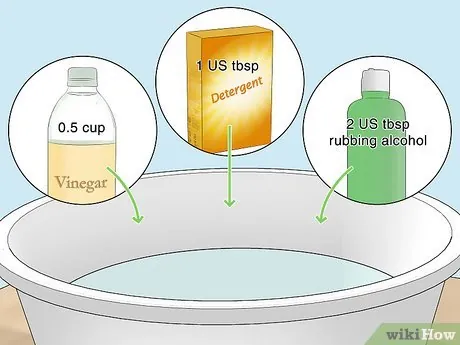
Gather these seven things before you touch the mess. A missing item costs you a second trip while the stain sits and spreads.
| Item | How much | Why it’s needed | A substitute |
|---|---|---|---|
| Enzyme pet cleaner | 1 bottle, follow label dose | Breaks down the protein in vomit | none — don’t swap this |
| Plain white paper towels | 10-15 sheets | Lifts wet matter and moisture | Clean white cloths |
| Cool water | 1 cup in a spray bottle | Rinses cleaner out of fibers | Bottled water, room temperature |
| Soft brush or sponge | 1, soft bristles only | Works cleaner into the pile | Old soft toothbrush |
| Rubber gloves | 1 pair | Keeps hands off the mess | none — don’t swap this |
| Plastic bag | 1, sealable | Holds the waste until the bin | Lined trash can |
| Flashlight | 1 | Shows wet spots in the pile | Phone light |
Before you start on the carpet stain
Move the cat and the food bowl first. A cat often returns to the same spot, and a fresh mess on a wet patch doubles the work. Shut the door to the room while you work if your cat keeps circling back.
Test the cleaner on a hidden corner. Spray a small patch under a chair or in a closet, wait 10 minutes, and check that the color doesn’t lift. Wool and some dyed carpets can fade. Blot the test spot dry rather than rubbing it in.
Vacuum the dry area around the mess, not the mess itself. A vacuum pulled over wet vomit pushes it deeper and can damage the machine. If the stain is already soaked through to the backing, skip the vacuum entirely and go straight to blotting.
Have a bag ready and keep the room ventilated. Cat vomit carries bacteria, so wear gloves and wash your hands after. Open a window, and bag the paper towels as you go rather than leaving them on the floor.
The step people skip is the patch test, and it’s the one that costs the most — a faded square in the middle of a living room is permanent. If the vomit contains blood, or your cat is being sick again and again, that’s a vet question, not a carpet question. Call your vet before you clean.
How do I clean cat throw up on carpet?
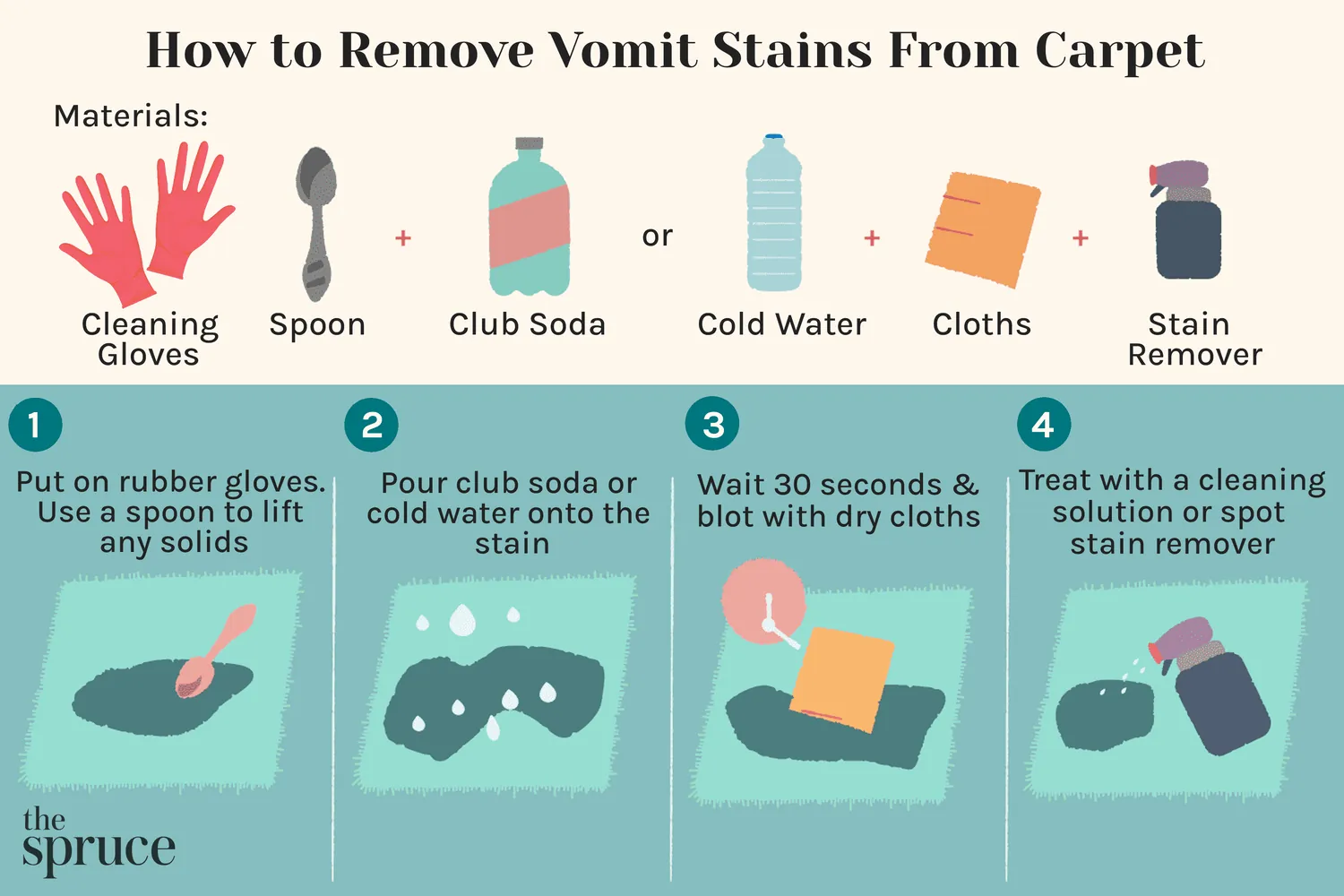
- Put on gloves and scoop the solids. Use paper towels or a plastic bag turned inside out. Work from the outside edge of the mess toward the middle so you don’t spread it. You’re done when no solid pieces lift away. Time: about 2 minutes.
- Blot the wet area with paper towels. Press straight down and hold for 10 seconds, then lift. Repeat with fresh towels until a new towel comes up barely damp. Don’t rub — rubbing pushes the stain into the backing. Time: 3-5 minutes.
- Spray cool water on the patch. Give it 3-4 light sprays, enough to dampen the pile but not soak through to the pad. Cool water lifts residue without setting it. You’ll see the area darken slightly and stop spreading.
- Blot the water back out. Press with clean towels the same way as step 2. The towel should come up slightly cloudy — that’s the residue leaving. If it’s clear, the surface is already clean and you can skip to step 6.
- Apply the enzyme cleaner at the label’s dose. Most pet enzyme cleaners say to saturate the stain and leave it wet for 10-15 minutes. Check your own bottle — some say 5 minutes, some say 30. Spread it evenly with a soft brush, working with the pile, not against it.
- Let it sit for the full dwell time on the label. Set a timer. Leaving it longer than the label says doesn’t clean better and can leave a sticky film that attracts dirt. The patch should look wet and slightly foamy.
- Blot the cleaner out with clean towels. Press and hold, then move to a dry spot on the towel. Keep going until towels come up almost dry. Time: 3-5 minutes for a small patch, longer for a big one.
- Rinse once with cool water and blot again. This removes cleaner residue that would otherwise trap dirt. One rinse is enough — more just pushes water deeper toward the pad.
- Cover the spot with a dry towel and weigh it down. A stack of books or a heavy pot works. Leave it for 30-60 minutes. This pulls moisture up out of the pile. The towel should feel damp when you lift it.
- Let it air dry fully, then vacuum. Keep the cat off it until it’s dry — usually 4-6 hours for a small patch, longer in humid weather. Vacuum with the brush attachment to lift the pile. It’s dry when the fibers spring back when you press them.
How to tell the carpet stain is really gone
The stain is gone when the patch looks the same shade as the carpet around it under a flashlight, and it stays that way after it dries. Wet carpet always looks darker, so judge it dry, not wet. Press a clean white paper towel onto the spot — if it comes up clean and dry, the surface is clear.
The smell is the harder test, and your nose stops noticing it after a few minutes in the room. Leave the room for 15 minutes, then come back in. A faint sour smell means the mess is still in the pad, and that needs another enzyme round, not more water. Cats have a much sharper sense of smell than people, so a smell you can barely catch is one your cat can find easily.
Watch for a ring around the edge of the patch. A brown or dark outline means the stain spread outward and dried at the border. That needs a second, wider application of enzyme cleaner, worked from the outside in.
Give it a second round if the patch still feels stiff or crunchy when dry. Stiffness means residue is left in the fibers. Rinse once more with cool water, blot, and dry with the towel-and-weight method.
When the carpet cleaning goes wrong
| What happened | Why | What to do |
|---|---|---|
| Stain came back after drying | Pad still holds protein | Apply enzyme cleaner again, let it dwell |
| Dark ring around the patch | Water spread the stain outward | Clean a wider area, work edge to middle |
| Carpet color faded | Cleaner too strong for the dye | Stop, check label, test another spot |
| Patch feels stiff and crunchy | Cleaner residue left in fibers | Rinse with cool water, blot, air dry |
| Sour smell won’t leave | Vomit reached the pad | Repeat enzyme, or call a carpet pro |
| Cat keeps returning to the spot | Smell still there to the cat | Clean again, then block the area |
A dark ring is the one worth slowing down for. It means your water carried the stain outward and dried at the edge, so scrubbing the middle again just pushes it back out.
Work a ring of clean water and cleaner around the outside of the mark first, then move inward. Keep the patch damp, not soaked.
On a wool carpet, fading shows up faster than on synthetic, so test on a closet corner before you treat the visible spot. If the color lifts on the test patch, stop and use plain cool water only.
The sour smell is the case where you should stop doing it yourself. A home machine rinses the surface, but the pad underneath stays contaminated, and that’s what keeps smelling.
How often to clean a cat vomit stain
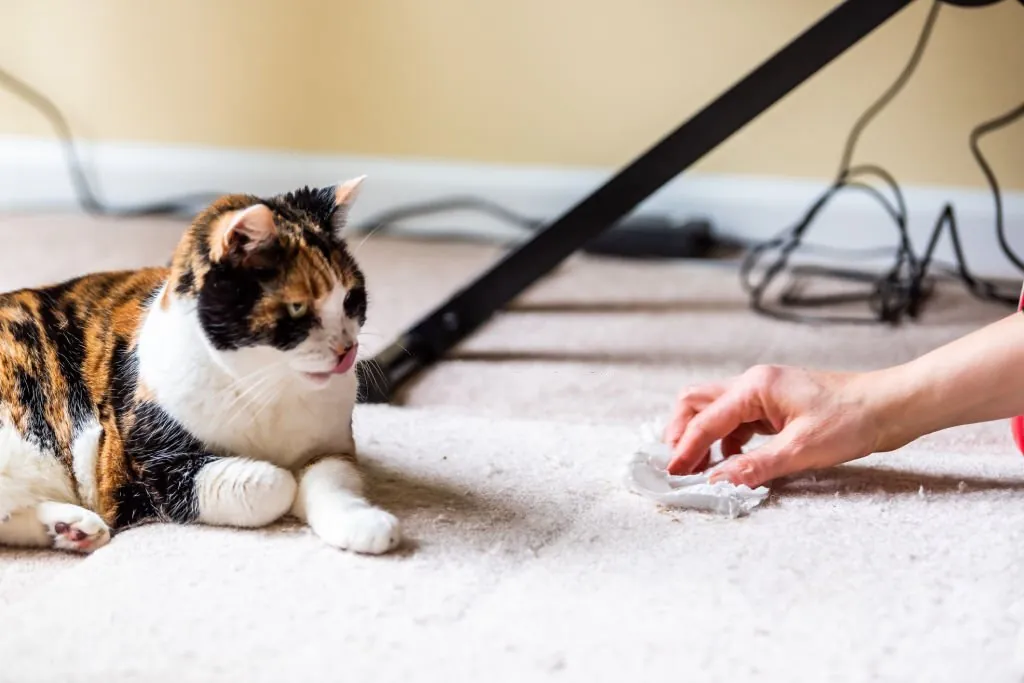
Clean a fresh cat vomit stain within 10 minutes if you can, and always within the same day. The longer it sits, the further the liquid travels down toward the pad, and the harder it’s to pull back out. A stain left overnight often needs two enzyme rounds instead of one.
Two things move that timing most. The first is what your cat ate — watery vomit from a hairball spreads faster than a firm, dry pile, so a runny mess needs cleaning first and questions later. The second is your carpet type. Short, tight pile holds liquid near the surface and gives you more time; thick, deep pile and a soft pad soak it up fast.
That difference is worth acting on. On a low-pile carpet, blotting within the hour is usually enough. On a deep shag or a carpet with a thick underpad, treat the clock as shorter than it looks.
Press a dry white paper towel into the spot. If moisture shows on the towel after a minute, the liquid is still near the surface and you have time. If the towel stays dry while the spot still smells, it has already reached the pad, and that stain needs the enzyme treatment today rather than tomorrow.
For the smell, recheck the spot after 24 hours. If it’s clear, you’re done. If not, one more enzyme round is cheaper than a professional clean. A carpet cleaning pro is worth calling when the stain is bigger than your hand or the smell has been there for days.
Frequently asked questions
Can I use white vinegar on cat vomit?
Yes, a diluted white vinegar rinse works as a backup if you have no enzyme cleaner. Mix 1 part white vinegar with 3 parts cool water, spray lightly, wait 5 minutes, then blot dry. Vinegar neutralizes some of the smell but doesn’t break down protein the way an enzyme cleaner does, so a stubborn stain may need the enzyme product afterward.
Why does the stain keep coming back after I clean it?
Because the liquid reached the pad under the carpet and never came out. The surface dries and looks clean, but moisture pulls the stain back up through the fibers. Fix it by applying enzyme cleaner, covering the spot with a dry towel, and weighing it down for 30-60 minutes so the moisture wicks up.
How long does it take for the smell to go away?
The smell usually fades within 24-48 hours after one proper enzyme treatment, assuming the liquid didn’t reach the pad. If it’s still there after 48 hours, the vomit soaked deeper than the surface clean could reach. A second enzyme round, left for the full dwell time on the label, is the next step before you pay for a professional clean.
Is cat vomit dangerous to clean without gloves?
Yes, use gloves. Cat vomit can carry bacteria and, in rare cases, parasites, so bare hands aren’t worth the risk. General hygiene guidance for pet waste recommends gloves and handwashing. Wash your hands with soap for at least 20 seconds after you finish, even if you wore gloves.
What happens if I use hot water on the stain?
Hot water can set the stain and the smell into the fibers, and it can bond the stain to the dye. Always use cool or room-temperature water, and never steam clean a fresh vomit stain. Wait until the spot is fully dry and the smell is gone before any hot-water cleaning.
Does it matter which enzyme cleaner I buy?
Not much, as long as it’s labeled for pet stains and enzymes. The label matters more than the brand — check the dwell time and the surfaces it can’t touch. A cleaner made for pet urine and vomit works on both. Skip bleach and ammonia products, which can damage carpet dye and are harsh in a closed room.
How long before my cat can walk on the carpet again?
Wait until the carpet is fully dry, usually 4-6 hours for a small patch in dry weather and up to 12 hours in humid conditions. Walking on damp carpet presses residue back into the fibers and spreads the smell. Test it by pressing a dry paper towel down — if it comes up dry, the cat can go back.
Can I just use a carpet shampoo machine?
Not on a fresh stain, no. Shampoo machines push water into the pad, and on a fresh vomit stain that spreads the mess wider. Use one only after the stain is fully dry and the smell is gone, and use the lowest water setting. For a single small stain, hand cleaning with enzyme cleaner is faster and safer.
Conclusion
Once the area is dry, run your fingers over the spot and give it a sniff. If you can still smell anything, a second pass with the enzyme cleaner usually finishes the job. Keep a small bottle on hand so the next mess doesn’t catch you off guard.