
Wool throw rugs are cleaned by hand-washing in cool water (about 86°F or below) with a pH-neutral wool detergent, then drying flat away from heat and sun. The job takes about 1 to 2 hours of hands-on work, plus 24 to 48 hours of flat drying. Cost is low: a pH-neutral wool wash and a clean towel. Difficulty is medium — or “needs care” if the rug has fringes, a backing, or a stain you’ve already treated.
What you need for cleaning a wool throw rug
| Item | How much | Why it’s needed | A substitute |
|---|---|---|---|
| pH-neutral wool detergent | 1–2 capfuls per 2 gallons | Cleans without stripping wool’s natural oils | none — don’t swap this |
| Cool water | Enough to cover the rug, 86°F or below | Keeps wool from felting and shrinking | none — don’t swap this |
| Two large bath towels | 2 | Soaks up water and cushions flat drying | 3 smaller towels |
| Absorbent white towel | 1 | Blots stains without dye transfer | Paper towels, in a pinch |
| Soft brush or sponge | 1 | Works suds in without scrubbing fibers | Clean soft toothbrush |
| Drying rack or mesh | 1 | Lets air reach both sides | Clean shower rail |
| Vacuum with bare-floor setting | 1 | Removes loose dirt before washing | Soft carpet brush |
Before you start cleaning a wool throw rug
- Vacuum both sides first. Run a vacuum on the bare-floor setting, no beater bar, over the front and back. Loose grit turns into mud once wet and works deeper into the fibers. This takes about 3 minutes on a standard 4 x 6 ft throw.
- Check the care label and test a hidden spot. Read the label on the rug’s backing. If it says dry clean only, stop there. If it allows water, wet a small corner with your detergent mix and wait 10 minutes to see how the color and pile react.
- Clear a drying space before you wet anything. A wet wool throw is heavy and needs a flat surface with airflow underneath for 24 to 48 hours. A bed with a towel over it works; a radiator or a sunny windowsill does not.
- Move anything the rug could stain. Wet wool can bleed dye onto floors, carpet or bedding. Put a plastic sheet or old towel underneath the drying spot first.
- Know where to stop. Rugs with a glued backing, a leather trim, or a value you’d hate to lose go to a professional rug cleaner. Water can lift the backing and the rug won’t go back together at home.
Step-by-step: washing a wool throw rug by hand
- Shake and vacuum the rug on both sides. Take it outside, shake it for 30 seconds, then vacuum front and back on the bare-floor setting. You’ll know it worked when no grit falls off the back when you lift it. This stops dirt turning into mud during washing.
- Fill a bathtub or large tub with cool water. Use water at 86°F or below — test it with the inside of your wrist, which is more sensitive to temperature than your palm. For a 4 x 6 ft throw, about 4 to 6 inches of water is enough to cover it. Warm or hot water is what makes wool felt and shrink.
- Add the detergent and mix it in fully. Pour 1 to 2 capfuls of pH-neutral wool wash into the water and stir until you see no streaks or clumps. The condition: this dose assumes a standard 2-gallon tub — for a smaller basin, use half. Undissolved detergent leaves patches that are hard to rinse out.
- Lower the rug in and press it under. Roll the rug loosely and lay it in, then press it down with flat hands until it’s fully submerged. Don’t lift it by one corner — the weight of the water stretches the weave. You’ll know it’s ready when no dry patches float up.
- Let it soak for 10 to 15 minutes. Set a timer. Longer soaks (over 30 minutes) give dye more chance to bleed, so keep it short. You’ll know it’s done when the water looks slightly cloudy but the rug still holds its shape.
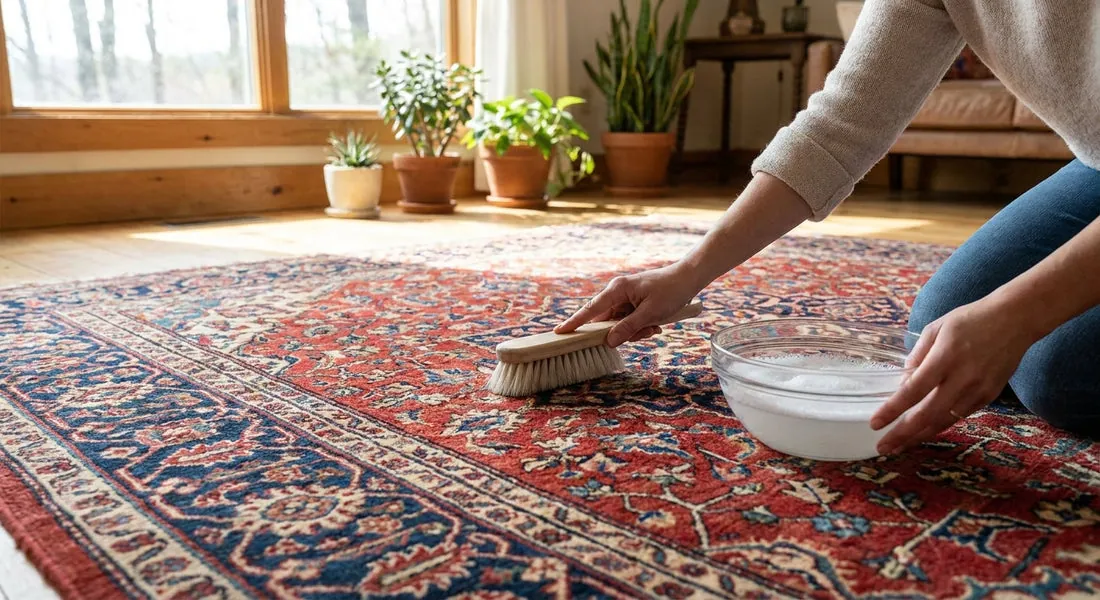
- Press the suds through, don’t scrub. Use flat hands or a soft sponge to push the soapy water through the pile in one direction, working in sections about the size of your palm. Scrubbing back and forth is what makes wool pill and mat. Stop when the whole surface has had one pass.
- Rinse with cool water until it runs clear. Lift the drain and refill with fresh cool water, or run a gentle cool shower over the rug while pressing it down. Repeat 2 to 3 times. You’ll know it’s done when the water leaving the rug is clear, not soapy.
- Press out the water — never wring or twist. Lay the rug flat and roll it up with a dry bath towel inside, then press down with your knees for 30 seconds. Repeat with a second towel. You’ll know it worked when the rug stops dripping and feels damp, not soaked.
- Dry it flat, away from heat and sun. Lay the rug pile-up on a drying rack or over a towel on a flat surface, and reshape the edges and fringes with your fingers. Direct sun and radiators can fade color and stiffen wool. Expect 24 to 48 hours; thicker rugs take the longer end.
- Vacuum gently once it’s fully dry. Use the bare-floor setting again, no beater bar, in the direction of the pile. You’ll know it’s dry when the backing feels dry to the touch in the middle, not just at the edges. Then it’s ready to go back on the floor.
How to tell your wool throw rug came out clean
The clearest sign is the rinse water: it should run clear after 2 to 3 rinses, with no soapy film on your fingers. A second sign is the pile — when you brush it with your hand in one direction, the fibers should spring back and lie flat, not clump or feel stiff. Stiffness usually means detergent left behind, and a second short rinse in cool water fixes it.
Check the backing too. Press the middle of the rug with a dry palm; if it feels cool and damp after 48 hours, it needs more drying time, not more washing. Wool that’s put back on the floor damp can grow mildew, and that smell is very hard to remove.
Fringes tell you a lot. They should be loose and separate, not matted into clumps — if they are, the rug was wrung or twisted during rinsing. Untangle them gently with your fingers while the rug is still damp and reshape them.
Signs it needs a second round: visible dirt still in the pile after drying, a dull or gray cast across the surface, or stains that look darker once dry than they did when wet.
In those cases, repeat the wash steps once — a second full wash is fine, but a third in a row starts to wear the fibers. If the stain survives two washes, stop and take it to a professional. For deeper guidance on wool fiber care, the International Wool Textile Organisation publishes fiber care information.
If something goes wrong with your wool throw rug
| What happened | Why | What to do |
|---|---|---|
| Rug shrank after washing | Water was too warm or dried with heat | Stretch gently while damp, dry flat, accept some change |
| Colors bled into each other | Dye ran in water that sat too long | Rinse in cool water at once, dry flat, don’t rewash |
| Pile feels stiff and scratchy | Detergent left in the fibers | Rinse once more in cool water, dry flat |
| Rug smells musty after drying | It stayed damp in the middle | Air it flat in moving air, not in sun |
| Fringes matted into clumps | Rug was wrung or twisted | Untangle damp with fingers, reshape, dry flat |
| Backing lifted or bubbled | Water got under a glued backing | Stop washing, take it to a rug cleaner |
Shrinkage is the one you can partly work with. Wool fibers lock together when they felt, and warm water speeds that up. Once the rug is dry and flat, the change is set, so the stretching has to happen while it’s still damp.
Work from the middle outward and pull a little at a time. Pulling hard on one corner stretches that corner out of shape and leaves the rest tight.
Bleeding is the case where doing less is right. Every extra rinse carries more dye into the pale areas, so one cool rinse and then flat drying gives the rug its best chance.
For a musty smell, check the middle of the rug with your palm before you air it. If it still feels cool and damp there, the rug needs more time flat in moving air, not a wash.
How often to clean a wool throw rug

Wash a wool throw rug by hand about once every 12 months in a low-traffic room, and every 6 months in a room where people walk in shoes or pets live. Those two things — foot traffic and pets — move the number more than anything else. A throw at the end of a bed sees far less wear than one by a front door.
Between washes, vacuum it weekly on the bare-floor setting and shake it outside monthly. Spot-clean spills within 24 hours with a damp white towel and a little wool detergent, blotting from the edge inward so the stain doesn’t spread. Wool is naturally stain-resistant on the surface, but liquid left overnight can soak down into the pile and backing.
No fixed schedule fits every rug. Wool density, pile height and how the rug is used all change how fast dirt builds up. The check you can do yourself: fold back a corner and look at the base of the pile. If it looks gray or feels gritty compared with the surface, it’s time — whatever the calendar says.
Frequently asked questions
Can you machine wash a wool throw rug?
Only if the care label says so. Most wool throw rugs are hand-wash only, because a machine’s agitation and spin cycle felt and shrink wool. If the label allows machine washing, use the wool or gentle cycle at 86°F or below, a pH-neutral wool detergent, and no spin above low. When in doubt, hand-wash — it’s slower but far safer for the rug.
Why did my wool rug shrink after washing?
Wool shrinks when it’s washed in water warmer than about 86°F, or dried near a radiator or in direct sun. The heat and movement make the fibers lock together — a process called felting — and it can’t be fully reversed. Once it happens, stretch the rug gently while damp and dry it flat. Some shrinkage may stay, so the best fix is prevention: cool water, no heat.
How long does a wool throw rug take to dry?
Plan on 24 to 48 hours drying flat, with thicker rugs at the longer end. Airflow matters more than heat — a drying rack in a room with a fan or open window dries faster than a warm room with no air movement. Never hang a wet wool rug over a line; the weight stretches it out of shape. Check the backing in the middle before putting it back.
Is it safe to use regular laundry detergent on wool?
No — use a pH-neutral wool detergent instead. Standard laundry detergents are often alkaline, and alkalinity strips the natural lanolin that keeps wool soft and water-resistant. That leaves the rug scratchy and dull over time. If you only have regular detergent, use a very small amount and rinse thoroughly, but a wool-specific wash is the better choice.
What happens if I scrub a stain on a wool rug?
Scrubbing mats the fibers and spreads the stain wider into the pile. Blot instead, working from the outside of the stain toward the middle with a clean white towel and a little cool water mixed with wool detergent. Press, lift, repeat. For an old or set-in stain, two gentle blotting rounds beat one hard scrub every time.
Does it matter which way I dry a wool throw rug?
Yes — dry it flat, pile-side up, and reshape the edges and fringes while it’s still damp. Hanging it stretches the weave under its own weight, and drying pile-down flattens the texture. Keep it out of direct sun and away from radiators, since both can fade color and stiffen the wool. Flat and cool with moving air is the safe setup.
Can I use a carpet cleaning machine on a wool throw rug?
Not on most wool throw rugs. Carpet cleaning machines push a lot of water and heat into the fibers, and wool backs can delaminate or stay damp for days. Some professional cleaners use low-moisture methods made for wool, but that’s their equipment and training, not a home machine. For a valuable or backed rug, book a professional instead.
How do I clean just one spot on a wool throw rug?
Blot the spill within 24 hours with a white towel, then dab a mix of 1 capful of pH-neutral wool detergent in 2 cups of cool water onto the spot. Press with a dry towel, repeat 2 to 3 times, and let it air-dry flat. Don’t rub, and don’t soak the whole rug for one small mark — spot cleaning handles most spills on its own.
Conclusion
Once it’s fully dry, give the rug a gentle shake and a light brush to lift the pile, then lay it back where it belongs. If you’re unsure about an old or delicate piece, it’s worth asking a professional before you try again.